Liberalism / Liberalismo

[ESPAÑOL ABAJO]

Liberal Politicians: Workers’ Enemy

Many heard Bernie Sanders and Alexandria Ocasio-Cortez (AOC) speak in LA and nationwide. People came who were angry at genocide and other fascist attacks. They wanted answers. 

ICWP comrades took Red Flag and a communist leaflet explaining that Sanders and AOC want to reform Capitalism. But to end genocide, imperialism, and all fascist attacks, we need to get rid of capitalism with communist revolution and build real communism.

The Sanders team set up fences and metal detectors. They prohibited communist literature in the park. They also took away peoples’ signs and banners, including many against genocide in Gaza. 

This didn’t stop ICWP comrades. They distributed literature to the people waiting to be searched. The irony of prohibiting communist literature and peoples’ signs against genocide at Sanders’ rally “defending democracy” was not lost on those we talked to.

Comrades said, “ Bernie is here to win you to reform the Democratic Party and capitalism. But we have to end capitalism with revolution and build a communist world that meets the needs of the masses. A world without borders or genocides.”

Most gladly thanked them for the leaflet and Red Flag. “I can see that Marx could have been wrong about the need for socialism as ‘transition’ phase to communism. As you say, it ended as state capitalism,” someone commented.

Many who came to hear these liberals were open to hearing that their reformism is not the answer to fascism and war: that communist revolution is. 

Another Comrade explained that Socialism failed to end exploitation in Russia and China because it kept money and wage slavery. As long as we work for someone else, we are slaves. Communism will get rid of capitalism’s wage slavery and money. These are the source of genocidal wars, and all capitalist poison: racism, sexism, homophobia, xenophobia. 

“Exactly how will communist society be administered?” asked one woman. Comrades explaiined that a mass party will lead collective production for need.

They pointed out that during the Weimar Republic in Germany, it was the social democrats (the liberals) who paved the way for Hitler by putting forward reform and attacking revolution. They fought to turn the masses away from revolution and communists.

Sanders introduced a token resolution in Congress to stop sending “offensive” weapons to Israel. Instead, he supports sending “defensive” weapons. That includes everything from the bulldozers to planes and bombs. Revealing his Zionism, he claims Israel has the “right to defend itself!” Congress, including Sanders, serves US imperialism. They are hell bent on supporting Israel’s genocide for oil and gas off the Gazan coast and expanding the unfolding world war to defend their declining empire. 

These liberals are dangerous. They are wolves in sheep’s clothing. They try to turn angry masses, especially youth, away from communist revolution into trying to peacefully reform capitalism. They advocate voting for the Democratic Party, the other US capitalist party of war and fascism. 

Reform movements, peace marches, or voting can’t end capitalism and imperialism. Declining US imperialism is headed to WWIII against their rising Chinese and Russian imperialist rivals. The rulers are building fascism–out of weakness. Communist revolution by the masses is the only solution. It requires a mass party which especially has roots among industrial workers, soldiers and youth committed to fighting for communism, nothing less. People are more open now—everywhere.

At many Sanders-AOC stops, youth boldly attacked the genocide in Gaza. In Idaho, protesters raised an anti-genocide banner. The crowd cheered and raised their fists. Sanders ignored them. When the police forced the protesters away, the crowd booed and gave the finger. Sanders said nothing! We invite these angry youth and all fighters against fascism to join ICWP’s fight to end it with communist revolution. 

[RETURN TO ENTRIES]

[TRADUCCIÓN PROVISIONAL]

Políticos liberales: enemigos de los trabajadores Muchos escucharon a Bernie Sanders y Alexandria Ocasio-Cortez (AOC) hablar en Los Ángeles y en todo el país. Acudieron personas indignadas por el genocidio y otros ataques fascistas. Querían respuestas. Los compañeros del ICWP llevaron Red Flag y un folleto comunista en el que se explicaba que Sanders y AOC quieren reformar el capitalismo. Pero para acabar con el genocidio, el imperialismo y todos los ataques fascistas, tenemos que acabar con el capitalismo mediante la revolución comunista y construir el comunismo real.

El equipo de Sanders instaló vallas y detectores de metales. Prohibieron la literatura comunista en el parque. También se llevaron los carteles y pancartas de la gente, incluidos muchos contra el genocidio en Gaza. Esto no detuvo a los compañeros del ICWP. Distribuyeron literatura a la gente que esperaba para ser registrada. La ironía de prohibir la literatura comunista y los carteles de la gente contra el genocidio en el mitin de Sanders «en defensa de la democracia» no pasó desapercibida para aquellos con quienes hablamos. Los compañeros dijeron: «

Bernie está aquí para ganarte para reformar el Partido Demócrata y el capitalismo. Pero tenemos que acabar con el capitalismo con la revolución y construir un mundo comunista que satisfaga las necesidades de las masas. Un mundo sin fronteras ni genocidios». La mayoría les agradeció con gusto el folleto y la bandera roja. «Veo que Marx podría haberse equivocado sobre la necesidad del socialismo como fase de «transición» al comunismo. Como tú dices, terminó como capitalismo de Estado», comentó alguien.

Muchos de los que acudieron a escuchar a estos liberales se mostraron abiertos a escuchar que su reformismo no es la respuesta al fascismo y la guerra, sino que lo es la revolución comunista. Otro camarada explicó que el socialismo no logró acabar con la explotación en Rusia y China porque mantuvo el dinero y la esclavitud salarial. Mientras trabajemos para otros, seremos esclavos. El comunismo acabará con la esclavitud salarial y el dinero del capitalismo. Estos son el origen de las guerras genocidas y de todo el veneno capitalista: el racismo, el sexismo, la homofobia, la xenofobia

. «¿Cómo se administrará exactamente la sociedad comunista?», preguntó una mujer. Los camaradas explicaron que un partido de masas dirigirá la producción colectiva para satisfacer las necesidades. Señalaron que durante la República de Weimar en Alemania, fueron los socialdemócratas (los liberales) quienes allanaron el camino a Hitler al proponer reformas y atacar la revolución. Lucharon para alejar a las masas de la revolución y de los comunistas

Sanders presentó una resolución simbólica en el Congreso para dejar de enviar armas «ofensivas» a Israel. En su lugar, apoya el envío de armas «defensivas». Eso incluye todo, desde excavadoras hasta aviones y bombas. Revelando su sionismo, afirma que Israel tiene «derecho a defenderse». El Congreso, incluido Sanders, sirve al imperialismo estadounidense. Están empeñados en apoyar el genocidio de Israel por el petróleo y el gas de la costa de Gaza y en ampliar la guerra mundial que se está desarrollando para defender su imperio en declive.

Estos liberales son peligrosos. Son lobos con piel de cordero. Intentan desviar a las masas enfurecidas, especialmente a los jóvenes, de la revolución comunista hacia el intento de reformar pacíficamente el capitalismo. Abogan por votar al Partido Demócrata, el otro partido capitalista estadounidense de la guerra y el fascismo.

Los movimientos reformistas, las marchas por la paz o el voto no pueden acabar con el capitalismo y el imperialismo. El imperialismo estadounidense en declive se encamina hacia la Tercera Guerra Mundial contra sus rivales imperialistas en ascenso, China y Rusia. Los gobernantes están construyendo el fascismo, desde la debilidad. La revolución comunista de las masas es la única solución. Requiere un partido de masas que tenga raíces especialmente entre los trabajadores industriales, los soldados y los jóvenes comprometidos con la lucha por el comunismo, nada menos

. La gente está más abierta ahora, en todas partes. En muchas paradas de Sanders y AOC, los jóvenes atacaron con valentía el genocidio en Gaza. En Idaho, los manifestantes levantaron una pancarta contra el genocidio. La multitud vitoreó y levantó los puños. Sanders los ignoró. Cuando la policía expulsó a los manifestantes, la multitud abucheó y les hizo gestos obscenos. ¡Sanders no dijo nada! Invitamos a estos jóvenes enfurecidos y a todos los luchadores contra el fascismo a unirse a la lucha del ICWP para acabar con él mediante la revolución comunista.

[VOLVER A LAS ENTRADAS]

Communist Revolution / Revolución Comunista

[ESPAÑOL ABAJO]

What is a Communist Revolution?

A Communist revolution is a worldwide working-class revolution based on the principle of fighting directly for a classless egalitarian communist world where everyone contributes to humanity, and everyone’s needs are met. 

Even after successful communist revolutions, vestiges of capitalism and class society will still exist in liberated zones. For instance, there will still be some segregated living conditions. Racist, sexist, nationalist, and antisocial behaviors will still remain widespread during the initial years after the end of capitalism. International capitalists and imperialists will use as much force as possible to attack liberated zones and try to bring back capitalism. Despite these fascist reactionary attacks, communist revolutionary masses will be able to defeat the last capitalist and eventually eliminate all these capitalist ideas and practices only if the masses are persistent enough.

Throughout history, the working-class masses have waged successful proletarian revolutions against the exploitative ruling class. For instance, the Haitian Revolution, the Paris Commune, the Bolshevik Revolution, the Chinese Revolution, and the Chinese Cultural Revolution were all crucial milestones. However, the proletarian revolutions were NOT communist revolutions, because they did not establish communism. Instead, they established socialism and the “dictatorship of the proletariat,” which are forms of state capitalism. 

Communist revolutions and proletarian revolutions are not the same thing. 

In a proletarian revolution, the working class overthrows the capitalist class and takes state power, hence the dictatorship of the proletariat. The dictatorship of the proletariat then establishes socialism and viciously suppresses the old bourgeoisie. Socialism keeps money and the wage system, and the top leaders of the dictatorship of the proletariat gradually become new bourgeois exploiters themselves, reversing the working-class victory. The new bourgeois rulers are called revisionists.

In a communist revolution, on the other hand, the workers of the world, led by a mass communist revolutionary party, overthrow the entire capitalist system. Unlike proletarian revolutions, communist revolutions will immediately abolish money, the wage system, and private property. The working class will cease to be the proletariat and become free workers. The communist masses in liberated zones will then begin implementing communism immediately and export the revolution to other regions and countries, and eventually the whole world. The communist revolutions will continue until the last capitalist is defeated, and all nations, borders, classes, and capitalist practices are wiped out.

To make successful communist revolutions, the working class needs a mass revolutionary communist organization dedicated to fighting directly for communism without turning revisionist (pro capitalist). This mass communist organization should seek to unite urban workers, rural workers (farmworkers), soldiers, sailors, and left-leaning sections of the petty bourgeoisie as one class. 

Most so-called “communist” parties today have sold out to the capitalists, and their leaders have become revisionists and reformists. Currently, the only revolutionary communist party in the world is the International Communist Workers Party (ICWP). It, too, risks becoming revisionist unless communist revolutionaries wage long-term communist struggles against capitalist practices and ideas within the communist movement.

Communist revolution must be the work of millions to billions of communist leaders, not just one single leader. For this reason, communist revolutionary leaders should put the interests of the international working class above all else. 

As history has shown, capitalists will not hesitate to attack communist workers with all the armed might they can muster. We will require a mass communist Red Army based on the principle of mobilizing the masses for communism. Military strategy and tactics will flow from this guiding principle. This armed force will not be separate from the working class, physically or ideologically. Only a disciplined mass communist party can organize such an armed force. 

Workers of the World, Unite for Communism! 

[TRADUCCIÓN PROVISIONAL]

¿Qué es una revolución comunista?

Una revolución comunista es una revolución mundial de la clase trabajadora basada en el principio de luchar directamente por un mundo comunista igualitario sin clases, donde todos contribuyan a la humanidad y se satisfagan las necesidades de todos. 

Incluso después de revoluciones comunistas exitosas, los vestigios del capitalismo y la sociedad de clases seguirán existiendo en las zonas liberadas. Por ejemplo, seguirá habiendo algunas condiciones de vida segregadas. Los comportamientos racistas, sexistas, nacionalistas y antisociales seguirán estando muy extendidos durante los primeros años tras el fin del capitalismo. Los capitalistas e imperialistas internacionales utilizarán toda la fuerza posible para atacar las zonas liberadas e intentar recuperar el capitalismo. A pesar de estos ataques reaccionarios fascistas, las masas revolucionarias comunistas podrán derrotar al último capitalista y, finalmente, eliminar todas estas ideas y prácticas capitalistas solo si las masas son lo suficientemente persistentes.

A lo largo de la historia, las masas de la clase trabajadora han llevado a cabo exitosas revoluciones proletarias contra la clase dominante explotadora. Por ejemplo, la Revolución Haitiana, la Comuna de París, la Revolución Bolchevique, la Revolución China y la Revolución Cultural China fueron hitos cruciales. Sin embargo, las revoluciones proletarias NO fueron revoluciones comunistas, porque no establecieron el comunismo. En su lugar, establecieron el socialismo y la «dictadura del proletariado», que son formas de capitalismo de estado. 

Las revoluciones comunistas y las revoluciones proletarias no son lo mismo.

En una revolución proletaria, la clase trabajadora derroca a la clase capitalista y toma el poder del Estado, de ahí la dictadura del proletariado. La dictadura del proletariado establece entonces el socialismo y reprime brutalmente a la vieja burguesía. El socialismo mantiene el dinero y el sistema salarial, y los principales líderes de la dictadura del proletariado se convierten gradualmente en nuevos explotadores burgueses, revirtiendo la victoria de la clase trabajadora. Los nuevos gobernantes burgueses se llaman revisionistas.

En una revolución comunista, por otro lado, los trabajadores del mundo, liderados por un partido revolucionario comunista de masas, derrocan todo el sistema capitalista. A diferencia de las revoluciones proletarias, las revoluciones comunistas abolirán inmediatamente el dinero, el sistema salarial y la propiedad privada. La clase trabajadora dejará de ser el proletariado y se convertirá en trabajadores libres. Las masas comunistas en las zonas liberadas comenzarán entonces a implementar el comunismo de inmediato y exportarán la revolución a otras regiones y países, y finalmente a todo el mundo. Las revoluciones comunistas continuarán hasta que el último capitalista sea derrotado y todas las naciones, fronteras, clases y prácticas capitalistas sean eliminadas.

Para que las revoluciones comunistas tengan éxito, la clase trabajadora necesita una organización comunista revolucionaria de masas dedicada a luchar directamente por el comunismo sin volverse revisionista (procapitalista). Esta organización comunista de masas debe tratar de unir a los trabajadores urbanos, los trabajadores rurales (campesinos), los soldados, los marineros y los sectores de izquierda de la pequeña burguesía en una sola clase. 

La mayoría de los llamados partidos «comunistas» de hoy se han vendido a los capitalistas, y sus líderes se han convertido en revisionistas y reformistas. Actualmente, el único partido comunista revolucionario en el mundo es el Partido Comunista Obrero Internacional (PCOI). También corre el riesgo de convertirse en revisionista a menos que los revolucionaraios comunistas emprendan luchas comunistas a largo plazo contra las prácticas e ideas capitalistas dentro del movimiento comunista.

La revolución comunista debe ser obra de millones o miles de millones de líderes comunistas, no de un solo líder. Por esta razón, los líderes revolucionarios comunistas deben anteponer los intereses de la clase trabajadora internacional a todo lo demás. 

Como ha demostrado la historia, los capitalistas no dudarán en atacar a los trabajadores comunistas con todo el poder armado que puedan reunir. Necesitaremos un Ejército Rojo comunista de masas basado en el principio de movilizar a las masas para el comunismo. La estrategia y las tácticas militares se derivarán de este principio rector. Esta fuerza armada no estará separada de la clase trabajadora, ni física ni ideológicamente. Solo un partido comunista de masas disciplinado puede organizar tal fuerza armada. 

¡Trabajadores del mundo, uníos al comunismo!

Unions – Origins / Syndicatos – Reseña

[ESPAÑOL ABAJO]

Communism and Unions

A Brief Historical Review

Before the existence of class society, human beings lived for 80,000 years in a classless society. The production of food, the construction of houses, and the organization of families was collective, for the common well-being of all, to meet human needs. There were no exploiters. This was pre-class communism.

Later, when humankind began producing surplus, this changed in a historical process of class struggle into slavery, as the greediest took the production of the collective as their own. Later, under the lineage of the kings, the new ruling class took the top of the social pyramid during the whole historical period known as feudalism. In this period, the primary production was agriculture. As feudalism developed further, the medieval workshop came into being.

Since medieval times, serfs who worked the land were forced off the land. They had to move to the cities to find work in the workshops. Workers and apprentices (unpaid workers) were forced to be hired by the “masters and their master societies” or face punishment for “vagrancy” (not working).

It was the wealthy artisans, the merchants, and the owners of the first banks who set up the first workshops which later became factories. The economically ruined serfs, or peasants, and artisans were forced to contract with their exploiters in order to survive. Because large fortunes were needed to set up a factory, the capitalists created a system to suit themselves and placed themselves at the top, condemning 99% of the world’s population to wage slavery which continues today.

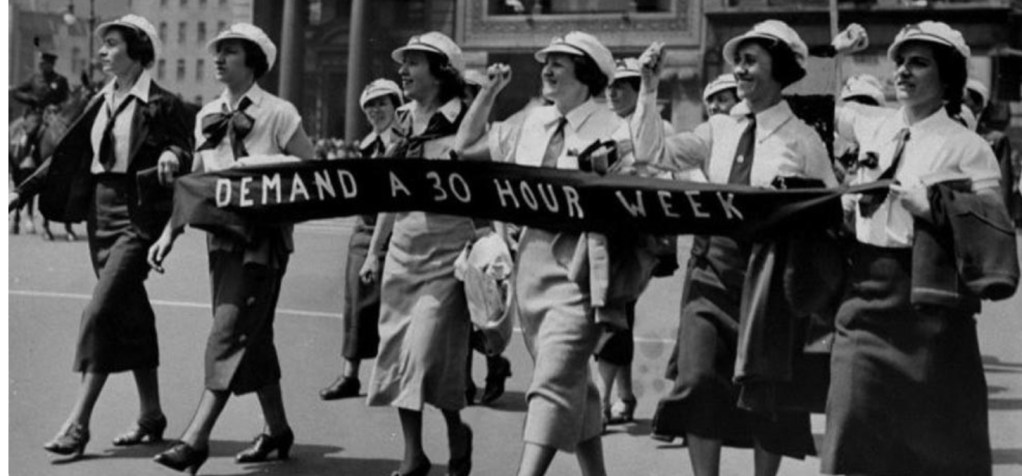
Trade unions in the past were first defined as the association formed by people who perform the same job, to promote and defend their moral and economic interests.

The origin of modern trade unions dates back to the Industrial Revolution, the time when technological development in countries such as England, France, and areas of today’s Germany led to the rise of the bourgeoisie (the capitalists) through war and mass murder. The unions were created inside the first factories as a response to the long working hours (up to 18 hours and even more), being forced to live confined in unhealthy, small spaces for workers’ families in the new cities, the starvation wages, and the exploitation of children among many other capitalist attacks.

The bourgeoisie took power by brute force. They imposed a new way of life in the factories that lasts to this day—of obedience and authority. The capitalists control the means of production and force us to work to produce profits for them in order to buy our daily food in a cycle that repeats itself every day until our death. It’s a new form of slavery.

The repetitive and daily labor tasks have condemned human beings to live most of their lives as machines. From the beginning of the new system, the bosses banned unions under very severe penalties because they fear any organization and struggle of the working class.

In summary, trade unions appeared at the end of the 18th century as a result of the development of the capitalist mode of production and the contradiction between the new social classes: bourgeois and proletarians.

A key point in the history of trade unions is that, since the consolidation of the capitalist system, trade unions were created not to transform the existing system but to fight for, within the limits of capitalism, the “improvement of working conditions,” i.e., reforms.

The activity of the unions recognizes and legitimizes the class division. It accepts negotiating with the exploiter (the boss). Instead, the masses need to fight to transform society to meet our needs.

[RETURN TO ENTRIES]

Comunismo y Sindicatos
Breve Reseña Histórica

Antes de la existencia de la sociedad de clases, los seres humanos vivieron durante 80 000 años en una sociedad sin clases. La producción de alimentos, la construcción de casas y la organización de las familias eran colectivas, para el bienestar común de todos, para satisfacer las necesidades humanas. No había explotadores. Esto fue el comunismo preclasista.

Más tarde, cuando la humanidad comenzó a producir excedentes, esto cambió en un proceso histórico de lucha de clases hacia la esclavitud, ya que los más codiciosos tomaron la producción de la colectividad como propia. Más tarde, bajo el linaje de los reyes, la nueva clase dominante tomó la cima de la pirámide social durante todo el período histórico conocido como feudalismo. En este período, la producción primaria era la agricultura. A medida que el feudalismo se desarrolló aún más, surgió el taller medieval.

Desde la época medieval, los siervos que trabajaban la tierra fueron expulsados de ella. Tuvieron que trasladarse a las ciudades para encontrar trabajo en los talleres. Los trabajadores y aprendices (trabajadores no remunerados) se vieron obligados a ser contratados por los «amos y sus sociedades de amos» o a enfrentarse a un castigo por «vagancia» (no trabajar).

Fueron los artesanos ricos, los comerciantes y los propietarios de los primeros bancos quienes crearon los primeros talleres que más tarde se convirtieron en fábricas. Los siervos o campesinos arruinados económicamente y los artesanos se vieron obligados a contratar a sus explotadores para sobrevivir. Debido a que se necesitaban grandes fortunas para establecer una fábrica, los capitalistas crearon un sistema que les convenía y se colocaron en la cima, condenando al 99 % de la población mundial a la esclavitud asalariada que continúa hasta hoy.

En el pasado, los sindicatos se definían como la asociación formada por personas que realizan el mismo trabajo, para promover y defender sus intereses morales y económicos.

El origen de los sindicatos modernos se remonta a la Revolución Industrial, época en la que el desarrollo tecnológico en países como Inglaterra, Francia y zonas de la actual Alemania condujo al auge de la burguesía (los capitalistas) a través de la guerra y el asesinato en masa. Los sindicatos se crearon en las primeras fábricas como respuesta a las largas jornadas laborales (de hasta 18 horas e incluso más), a la obligación de vivir confinados en espacios pequeños e insalubres para las familias de los trabajadores en las nuevas ciudades, a los salarios de miseria y a la explotación de los niños, entre muchos otros ataques capitalistas.

La burguesía tomó el poder por la fuerza bruta. Impusieron una nueva forma de vida en las fábricas que perdura hasta nuestros días: de obediencia y autoridad. Los capitalistas controlan los medios de producción y nos obligan a trabajar para producirles beneficios con el fin de comprar nuestra comida diaria en un ciclo que se repite cada día hasta nuestra muerte. Es una nueva forma de esclavitud.

Las tareas laborales repetitivas y diarias han condenado a los seres humanos a vivir la mayor parte de sus vidas como máquinas. Desde el comienzo del nuevo sistema, los jefes prohibieron los sindicatos bajo penas muy severas porque temen cualquier organización y lucha de la clase trabajadora.

En resumen, los sindicatos aparecieron a finales del siglo XVIII como resultado del desarrollo del modo de producción capitalista y la contradicción entre las nuevas clases sociales: burgueses y proletarios.

Un punto clave en la historia de los sindicatos es que, desde la consolidación del sistema capitalista, los sindicatos se crearon no para transformar el sistema existente, sino para luchar, dentro de los límites del capitalismo, por la «mejora de las condiciones de trabajo», es decir, por reformas.

La actividad de los sindicatos reconoce y legitima la división de clases. Acepta negociar con el explotador (el jefe). En cambio, las masas deben luchar para transformar la sociedad y satisfacer nuestras necesidades.

[VOLVER A LAS ENTRADAS]

Unions / Syndicatos

Communism, not Unions, Will Liberate Us from Wage Slavery

Unions emerged not as revolutionary organizations to overthrow capitalism. {see link}.Unfortunately since workers didn’t yet have a dialectical materialist understanding of capitalism, they limited their struggle to reforming capitalism, trying to improve wages, working conditions and other benefits but still keeping wage slavery.

Fighting only for temporary improvements favors the continued exploitation of the workers in maquilas, mines, construction, hospitals, and everywhere. It helps increase the quantity and pace of work. Today, everything is more expensive. We have to work more. Our wages are not enough to cover our basic needs. These are chains that we communists need to break.

Another error of the old communist movement was to believe in first winning power through either elections or revolutions that leave the bourgeois state intact, in order to then fight for socialism and, sometime in the future, communism.

We could make a very long list of the betrayals that the union leaders have committed: How they have divided the workers, creating up to 5 or 7 unions in the same factory; how they protect only the members of their own union and leave out the other workers in the same factory in the face of the bosses’ attacks. How the union leaders in the United States now travel in private jets and get luxuries for negotiating and betraying the workers in the factory, among other betrayals. 

By reviewing history, we realize that the unions, both in the past and today, are not the way to liberate ourselves from capitalist wage slavery because, in essence, they accept it.

The list could go on. The International Communist Workers’ Party calls not to fight for crumbs or leftovers as the current union leaders do and will always do. Instead, we call for fighting directly to win all men and women workers in all the factories in the world to fight to eliminate wage slavery with communist revolution. 

So that the workers who produce all the food, clothing, cars, housing, etc., become the real owners of the factories and all society. So collectively we determine what, how much, and how to produce. So that all workers can balance life in the factory with life with their family.

Comrades, friends, co-workers, workers of the world, ICWP does not attack or condemn those workers who are members of a union and who from there are fighting against the bosses’ abuse and mistreatment, day by day for a dignified life. However, we are warning you that the union struggle leads to a dead end. It perpetuates the capitalist horrors. 

Therefore, we invite you to join the International Communist Workers’ Party and fight for political strikes that will definitively transform your life, to fight to win power and to be the ones who define the course of your life and that of your families. Where each person receives according to his or her needs and each works according to his or her commitment and ability. That is real communism.

We need to wage a struggle that does not involve crumbs (reforms), which can be taken away, destroyed, and trampled on by the bosses who are also friends and allies of the union leaders. They negotiate with them and buy them with large sums of money. The bosses also control the so-called “democratic governments.” We must fight to change forever the course of our lives.

The road forward is the active and direct struggle for communism. A society without bosses, profits, or money, where we collectively meet the needs of our class. Join collectives of the International Workers’ Party and build our worker-peasant-soldier army and take power. Let’s start reading and distributing Red Flag newspaper.

Communism or Barbarism!

[RETURN TO ENTRIES]

[TRADUCCIÓN PROVISIONAL]

El comunismo, no los sindicatos, nos liberará de la esclavitud salarial

Los sindicatos no surgieron como organizaciones revolucionarias para derrocar el capitalismo. {ver enlace}. Desafortunadamente, como los trabajadores aún no tenían una comprensión materialista dialéctica del capitalismo, limitaron su lucha a reformar el capitalismo, tratando de mejorar los salarios, las condiciones de trabajo y otros beneficios, pero manteniendo la esclavitud salarial.

Luchar solo por mejoras temporales favorece la continua explotación de los trabajadores en las maquilas, las minas, la construcción, los hospitales y en todas partes. Ayuda a aumentar la cantidad y el ritmo de trabajo. Hoy en día, todo es más caro. Tenemos que trabajar más. Nuestros salarios no son suficientes para cubrir nuestras necesidades básicas. Estas son cadenas que los comunistas debemos romper.

Otro error del viejo movimiento comunista fue creer en ganar primero el poder a través de elecciones o revoluciones que dejaran intacto el estado burgués, para luego luchar por el socialismo y, en algún momento en el futuro, por el comunismo.

Podríamos hacer una lista muy larga de las traiciones que han cometido los líderes sindicales: cómo han dividido a los trabajadores, creando hasta 5 o 7 sindicatos en la misma fábrica; cómo protegen solo a los miembros de su propio sindicato y dejan de lado a los demás trabajadores de la misma fábrica ante los ataques de los jefes. Cómo los líderes sindicales en Estados Unidos ahora viajan en jets privados y obtienen lujos por negociar y traicionar a los trabajadores en la fábrica, entre otras traiciones.

Al revisar la historia, nos damos cuenta de que los sindicatos, tanto en el pasado como en la actualidad, no son la forma de liberarnos de la esclavitud salarial capitalista porque, en esencia, la aceptan.

La lista podría continuar. El Partido Comunista Obrero Internacional llama a no luchar por migajas o sobras como hacen y harán siempre los actuales líderes sindicales. En su lugar, llamamos a luchar directamente para ganar a todos los trabajadores y trabajadoras de todas las fábricas del mundo a luchar para eliminar la esclavitud asalariada con la revolución comunista.

Para que los trabajadores que producen todos los alimentos, ropa, automóviles, viviendas, etc., se conviertan en los verdaderos dueños de las fábricas y de toda la sociedad. Para que colectivamente determinemos qué, cuánto y cómo producir. Para que todos los trabajadores puedan equilibrar la vida en la fábrica con la vida con su familia.

Camaradas, amigos, compañeros de trabajo, trabajadores del mundo, el PCOI no ataca ni condena a aquellos trabajadores que son miembros de un sindicato y que desde allí luchan contra el abuso y el maltrato de los patrones, día a día por una vida digna. Sin embargo, les advertimos que la lucha sindical conduce a un callejón sin salida. Perpetúa los horrores capitalistas.

Por lo tanto, los invitamos a unirse al Partido Comunista Obrero Internacional y luchar por huelgas políticas que transformarán definitivamente su vida, luchar para ganar el poder y ser quienes definan el rumbo de su vida y la de sus familias. Donde cada persona reciba según sus necesidades y cada uno trabaje según su compromiso y capacidad. Eso es el comunismo real.

Necesitamos librar una lucha que no implique migajas (reformas), que pueden ser arrebatadas, destruidas y pisoteadas por los jefes que también son amigos y aliados de los líderes sindicales. Ellos negocian con ellos y los compran con grandes sumas de dinero. Los jefes también controlan los llamados «gobiernos democráticos». Debemos luchar para cambiar para siempre el curso de nuestras vidas.

El camino a seguir es la lucha activa y directa por el comunismo. Una sociedad sin patrones, ganancias o dinero, donde satisfagamos colectivamente las necesidades de nuestra clase. Únete a los colectivos del Partido Obrero Internacional y construyamos nuestro ejército de trabajadores, campesinos y soldados y tomemos el poder. Empecemos a leer y distribuir el periódico Bandera Roja.

¡Comunismo o barbarie!

[VOLVER A LAS ENTRADAS]

Reformism / Reformismo

[ESPAÑOL ABAJO]

Reformism is the belief that capitalism can be improved. Reformists want better wages, safer jobs, universal healthcare, affordable housing, and legal protections for oppressed groups. They want the system to be fairer, not abolished.

For over a century, many on the left believed this was a first step toward revolution. Even communists used to argue that leading militant reform struggles—like strikes for higher pay or campaigns for stronger unions—would expose the limits of capitalism and lead workers to demand more. The theory was that fighting for reforms would radicalize people, teaching them to trust their own power and take the next step toward communism.

But that theory didn’t work.

Instead of preparing the ground for revolution, it grew new reformists. Workers won some reforms—and often, they were grateful to the unions or politicians who delivered them. They got just enough to believe in the system, not break from it. When those reforms were later reversed or crushed—as they always are under capitalism—many were disillusioned and dropped out of struggle entirely. Rather than becoming communists, they became disappointed reformers.

Capitalism can’t be reformed. Its engine is profit. To keep profits flowing, bosses must exploit labor, fuel racism and sexism, control the state, and make war. Any reform that cuts into profit is attacked. Gains are rolled back by courts, legislation, police, or economic crisis. Wage increases can’t keep up with inflation.

And yet reformism is seductive. It promises quick results. It urges us to be “practical.” It tells us to vote for the lesser evil, pass one more law, elect one more progressive. But this only drains energy from revolution. Reformism teaches people to appeal to power, not to seize it.

Some reformists say we must pass through “stages”—first winning democracy or independence, then later fighting for socialism. History shows this doesn’t work either. Nationalist leaders always strike deals with imperialists and suppress workers’ movements. The local elite replaces the foreign one, and capitalism continues.

Even the “socialist” stage once imagined by communists has proven to be a dead end. The old idea of socialism as a transitional phase—with state-run industries, wages, and money—turned out to be state capitalism. The bosses were replaced by bureaucrats, who themselves became bosses, and exploitation remained.

Today, communists reject reformism and the two-stage theory. We reject the idea of socialism as a halfway house. We fight directly for communism—a society without money, wages, private property, borders, or the state. We don’t wait for a perfect moment osr a gradual shift. We organize now for the revolutionary overthrow of capitalism.

That doesn’t mean we ignore workers’ struggles. On the contrary, we participate in them—but not to win temporary reforms. We take part them to build relationships, to spread communist ideas, and to fight for a new kind of power.  We see reform struggles as an opportunity to win angry workers in struggle to see that communism will end their wage slavery, to show that workers can run society and produce collectively to meet our needs instead of their profits.

Reformism is not a stepping stone. It’s a trap. Communists don’t want a nicer version of capitalism; there is none. We want to destroy it. That’s the message we bring to every strike, every protest, every school and workplace. Not hope in elections or reforms, but confidence in the power of the working class to transform the world.

[RETURN TO ENTRIES]

[TRADUCCIÓN PROVISIONAL]

El reformismo es la creencia de que el capitalismo puede mejorarse. Los reformistas quieren mejores salarios, empleos más seguros, sanidad universal, viviendas asequibles y protección legal para los grupos oprimidos. Quieren que el sistema sea más justo, no que se abol

Durante más de un siglo, muchos en la izquierda creyeron que este era un primer paso hacia la revolución. Incluso los comunistas solían argumentar que liderar luchas reformistas militantes, como huelgas por salarios más altos o campañas por sindicatos más fuertes, expondría los límites del capitalismo y llevaría a los trabajadores a exigir más. La teoría era que luchar por las reformas radicalizaría a la gente, enseñándoles a confiar en su propio poder y a dar el siguiente paso hacia el comunismo.

Pero esa teoría no funcionó.

En lugar de preparar el terreno para la revolución, hizo crecer a nuevos reformistas. Los trabajadores consiguieron algunas reformas y, a menudo, se mostraron agradecidos a los sindicatos o a los políticos que las lograron. Obtuvieron lo justo para creer en el sistema, no para romper con él. Cuando esas reformas fueron posteriormente revocadas o aplastadas, como siempre ocurre bajo el capitalismo, muchos se desilusionaron y abandonaron por completo la lucha. En lugar de convertirse en comunistas, se convirtieron en reformistas decepcionados.

El capitalismo no se puede reformar. Su motor es el beneficio. Para que los beneficios sigan fluyendo, los jefes deben explotar la mano de obra, alimentar el racismo y el sexismo, controlar el Estado y hacer la guerra. Cualquier reforma que reduzca los beneficios es atacada. Las conquistas se revierten mediante los tribunales, la legislación, la policía o la crisis económica. Los aumentos salariales no pueden seguir el ritmo de la inflación.

Y, sin embargo, el reformismo es seductor. Promete resultados rápidos. Nos insta a ser «prácticos». Nos dice que votemos por el mal menor, que aprobemos una ley más, que elijamos a un progresista más. Pero esto solo agota la energía de la revolución. El reformismo enseña a la gente a apelar al poder, no a tomarlo.
Algunos reformistas dicen que debemos pasar por «etapas»: primero conquistar la democracia o la independencia y luego luchar por el socialismo. La historia demuestra que esto tampoco funciona. Los líderes nacionalistas siempre llegan a acuerdos con los imperialistas y reprimen los movimientos obreros. La élite local sustituye a la extranjera y el capitalismo continúa.

Incluso la etapa «socialista» que imaginaron en su día los comunistas ha demostrado ser un callejón sin salida. La vieja idea del socialismo como fase de transición —con industrias, salarios y dinero estatales— resultó ser capitalismo de Estado. Los jefes fueron sustituidos por burócratas, que se convirtieron ellos mismos en jefes, y la explotación se mantuvo.

Hoy, los comunistas rechazamos el reformismo y la teoría de las dos etapas. Rechazamos la idea del socialismo como una solución a medias. Luchamos directamente por el comunismo, una sociedad sin dinero, salarios, propiedad privada, fronteras ni Estado. No esperamos un momento perfecto ni un cambio gradual. Nos organizamos ahora para el derrocamiento revolucionario del capitalismo.

Eso no significa que ignoremos las luchas de los trabajadores. Al contrario, participamos en ellas, pero no para conseguir reformas temporales. Participamos en ellas para construir relaciones, difundir las ideas comunistas y luchar por un nuevo tipo de poder. Consideramos las luchas reformistas como una oportunidad para ganar a los trabajadores enfadados en la lucha, para que vean que el comunismo acabará con su esclavitud salarial, para demostrar que los trabajadores pueden dirigir la sociedad y producir colectivamente para satisfacer nuestras necesidades en lugar de sus beneficios.

El reformismo no es un peldaño. Es una trampa. Los comunistas no queremos una versión más amable del capitalismo; no existe. Queremos destruirlo.

Ese es el mensaje que llevamos a cada huelga, a cada protesta, a cada escuela y lugar de trabajo. No esperanza en las elecciones o en las reformas, sino confianza en el poder de la clase obrera para transformar el mundo.

[VOLVER A LAS ENTRADAS]

Revolution / Revolución

Many people think communism is great but don’t believe we’ll ever achieve it. After all, establishing communism requires a revolution, and (supposedly) revolutions are rare. 

In fact, revolutions (and potentially revolutionary situations) are not rare. 

In 1804, the African slaves of Haiti overthrew the French slaveowners and set up a republic which even Napoleon couldn’t crush. They had produced sugar can for the worldwide capitalist market, making French capitalists very rich. The fought the French, Spanish and British armies for ten years before defeating them all. After slavery was abolished, they refused to return to the sugar cane plantations as wage slaves. Instead, they burned the remaining plantations and produced food for their own needs in the hills. They defeated slavery and, for 100 years, wage slavery as well.

The Paris Commune of 1871 was a defining moment in history when the working class seized power for only the second time time. Though it lasted only 71 days, its impact was profound, shaping revolutionary movements worldwide. It inspired Marx, the Bolsheviks, the Chinese Revolution, and today’s fight for communism. The International Communist Workers’ Party (ICWP) looks to the Commune as a powerful example of how workers can overthrow capitalism and build a society that serves their interests.

In 1905 Russia erupted in revolt. The Tsar had launched a war against Japan and lost badly. The revolt was eventually crushed but the young Bolshevik party survived. From the sailors’ revolt on the battleship Potemkin, th3e Bolsheviks learned the importance of organizing in the rulers’ military.

In 1914 WWI broke out and, with it, massive slaughter. Russia suffered heavily. In early 1917 tsarism collapsed. The capitalists who took over continued the hated war and by October the Bolsheviks led the workers and soldiers to take state power. Industrial workers and soldiers acted  on their slogan, “Turn the imperialist war into a war for workers’ power.”

The Russian revolution was a powerful inspiration for workers everywhere. But their own internal contradictions eventually defeated them. They fought for socialism, not communism. Rather than being a transition to communism, socialism was shown to be state capitalism. 

Another opportunity for revolution was Spain. In 1936 fascists attempted a coup that was only partially successful. The Spanish state was shattered.Left-wing militias took over in Madrid, Barcelona, and other cities. Power was within reach but the left (led by the now revisionist official Communist party) threw away the opportunity. In the resulting civil war, they fought for not for communism but for the republic and “antifascism”. With aid from fascist Germany, fascist Franco defeated the anti-fascist forces.

In May 1936 in France there was a general strike with workers occupying the factories. However, the Socialists and revisionist Communists (allies in the Popular Front government) traded revolution in return for a reform – paid vacations. 

Imperialist war is an opportunity for revolution. WWII was no exception.

With great sacrifice and commitment, the Russian workers defeated the Nazis. By 1945 the Soviets were at the gates of Western Europe

In Albania and Yugoslavia communist partisans (anti-Nazi guerrillas) took power. The same thing nearly happened in Italy and France, but the revisionist leadership surrendered their weapons to the capitalists for temporary cabinet seats in a coalition government. 

In China, the Japanese surrender opened the door to the Chinese Red Army, which had been fighting the Japanese for many years. The massive Communist-led Red Army and militia went on the offensive in 1947 and triumphed in 1949, taking power in Chian.

After 1945 revolutions for national liberation  broke out all over the colonial world, most notably the Algerian war of independence. The Vietnam revolution lasted till 1975.

In January 1966 the Chinese Cultural Revolution – the first revolution against revisionism – began. Masses of students, workers and peasants fought the “red Bourgeoisie” for power.  

In May 1968 workers in France occupied factories and students occupied universities. Their mass uprising failed for the lack of a communist party with the goal of communist revolution.

This brief history shows that the oppressed have fought bravely against oppression. Only a communist revolution will finally end it.  If you want the coming revolutions to end exploitation, genocide and all oppression, join ICWP.

[TRADUCCIÓN PROVISIONAL]

Mucha gente piensa que el comunismo es genial, pero no cree que lo consigamos nunca. Después de todo, establecer el comunismo requiere una revolución y (supuestamente) las revoluciones son poco frecuentes.

De hecho, las revoluciones (y las situaciones potencialmente revolucionarias) no son raras.

En 1804, los esclavos africanos de Haití derrocaron a los esclavistas franceses y establecieron una república que ni siquiera Napoleón pudo aplastar. Habían producido caña de azúcar para el mercado capitalista mundial, enriqueciendo mucho a los capitalistas franceses. Lucharon contra los ejércitos francés, español y británico durante diez años antes de derrotarlos a todos. Después de que se aboliera la esclavitud, se negaron a volver a las plantaciones de caña de azúcar como esclavos asalariados. En su lugar, quemaron las plantaciones restantes y produjeron alimentos para sus propias necesidades en las colinas. Derrotaron la esclavitud y, durante 100 años, también la esclavitud asalariada.

La Comuna de París de 1871 fue un momento decisivo en la historia en el que la clase trabajadora tomó el poder por segunda vez. Aunque duró solo 71 días, su impacto fue profundo y dio forma a movimientos revolucionarios en todo el mundo. Inspiró a Marx, a los bolcheviques, a la Revolución China y a la lucha actual por el comunismo. El Partido Comunista Obrero Internacional (PCOI) considera la Comuna como un poderoso ejemplo de cómo los trabajadores pueden derrocar el capitalismo y construir una sociedad que sirva a sus intereses.

En 1905, Rusia estalló en revuelta. El zar había lanzado una guerra contra Japón y la había perdido estrepitosamente. La revuelta fue finalmente aplastada, pero el joven partido bolchevique sobrevivió. A partir de la revuelta de los marineros en el acorazado Potemkin, los bolcheviques aprendieron la importancia de organizarse en el ejército de los gobernantes.

En 1914 estalló la Primera Guerra Mundial y, con ella, una matanza masiva. Rusia sufrió mucho. A principios de 1917, el zarismo se derrumbó. Los capitalistas que tomaron el poder continuaron la odiada guerra y, en octubre, los bolcheviques llevaron a los trabajadores y soldados a tomar el poder del Estado. Los trabajadores industriales y los soldados actuaron siguiendo su lema: «Convertir la guerra imperialista en una guerra por el poder de los trabajadores».

La revolución rusa fue una poderosa inspiración para los trabajadores de todo el mundo. Pero sus propias contradicciones internas acabaron derrotándolos. Lucharon por el socialismo, no por el comunismo. En lugar de ser una transición al comunismo, el socialismo demostró ser capitalismo de estado.

Otra oportunidad para la revolución fue España. En 1936, los fascistas intentaron un golpe de estado que solo tuvo un éxito parcial. El estado español quedó destrozado. Las milicias de izquierda tomaron el control de Madrid, Barcelona y otras ciudades. El poder estaba al alcance de la mano, pero la izquierda (liderada por el ahora revisionista Partido Comunista oficial) desperdició la oportunidad. En la guerra civil resultante, lucharon no por el comunismo, sino por la república y el «antifascismo». Con la ayuda de la Alemania fascista, el fascista Franco derrotó a las fuerzas antifascistas.

En mayo de 1936, en Francia hubo una huelga general en la que los trabajadores ocuparon las fábricas. Sin embargo, los socialistas y los comunistas revisionistas (aliados en el gobierno del Frente Popular) cambiaron la revolución por una reforma: las vacaciones pagadas.

La guerra imperialista es una oportunidad para la revolución. La Segunda Guerra Mundial no fue una excepción.

Con gran sacrificio y compromiso, los trabajadores rusos derrotaron a los nazis. En 1945, los soviéticos estaban a las puertas de Europa occidental.

En Albania y Yugoslavia, los partisanos comunistas (guerrillas antinazis) tomaron el poder. Lo mismo casi ocurrió en Italia y Francia, pero los líderes revisionistas entregaron sus armas a los capitalistas a cambio de escaños temporales en el gabinete de un gobierno de coalición.

En China, la rendición japonesa abrió la puerta al Ejército Rojo chino, que había estado luchando contra los japoneses durante muchos años. El enorme Ejército Rojo y la milicia liderados por los comunistas pasaron a la ofensiva en 1947 y triunfaron en 1949, tomando el poder en China.

Después de 1945, estallaron revoluciones de liberación nacional en todo el mundo colonial, sobre todo la guerra de independencia de Argelia. La revolución de Vietnam duró hasta 1975.

En enero de 1966 comenzó la Revolución Cultural China, la primera revolución contra el revisionismo. Masas de estudiantes, trabajadores y campesinos lucharon contra la «burguesía roja» por el poder.

En mayo de 1968, los trabajadores de Francia ocuparon fábricas y los estudiantes ocuparon universidades. Su levantamiento masivo fracasó por la falta de un partido comunista con el objetivo de la revolución comunista.

Esta breve historia muestra que los oprimidos han luchado valientemente contra la opresión. Solo una revolución comunista la acabará finalmente. Si quieres que las próximas revoluciones acaben con la explotación, el genocidio y toda opresión, únete a la ICW.

[VOLVER A LAS ENTRADAS]

Mobilize the Masses for Communism / Movilizar a las Masas para el Comunismo

[ESPAÑOL ABAJO]

The International Communist Workers Party (ICWP) calls on the international working class to join us in mobilizing the masses for communism. This is the principle by which we are organizing to overthrow capitalism, and the principle by which we will build communism. We fight for communism because only communism can free us from what Lenin called capitalism’s “horror without end”. Under communism the party will mobilize the masses to provide everyone’s food, shelter, healthcare and all other needs, for free.

We fight for communism, not for “democracy”, not for “national liberation”, not for “progressive” capitalism. And, most importantly, not for socialism. History shows that socialism leads directly back to capitalism. In fact, socialism is already a form of capitalism – state capitalism. The communists who managed socialism (e.g. in Russia and China) eventually became revisionists – capitalists disguised as communists.

A communist revolution must be the work of millions of communist workers. For this reason ICWP is a mass party, open to all who agree that a communist revolution is the only solution.

As soon as we take power we will mobilize the masses to build communism. This means first of all the immediate abolition of money, commodity production (producing goods for a market) the wage system and any kind of privileges. Workers will be motivated not by the prospect of individual gain, but by the possibility – and, increasingly, the experience – of living in a communist society. We will thoroughly reorganize all aspects of society, including education, health care, housing and transportation.

Of high priority is smashing racism, sexism and all other forms of discrimination. Open racism or sexism, whether in word or deed, will not be tolerated. But we must go even further, and root out the material basis of racism and sexism. The abolition of money will itself be a powerful blow. When there are no wages, there can be no racist or sexist wage differentials, which currently give the capitalists a huge economic incentive to maintain these kinds of discrimination. In allocating food and shelter, the Party must ensure that no group receives less than a fair share. Finally, we will end segregation (for vocations, housing, and education).

In the past communist parties often mobilized around reform struggles. The theory was that in the heat of the struggle for reforms, workers’ consciousness would be spontaneously transformed into communist consciousness. This theory never worked.

Mobilizing workers for communism means first of all, having them join the communist party – the ICWP. We measure victory, in part, by how many we have mobilized to read, sell and write for Red Flag. We build study/action groups centered on the job, barracks and classrooms to debate communist ideas and put them into practice in the class struggle. We build and participate in every genuine fight-back with the aim of mobilizing the masses for communism.

The continuing crisis of overproduction and the continuing financial instability have made millions realize that capitalism cannot even guarantee food on the table and a roof over their heads. And finally, the ceaseless bloody “small” wars and the obvious preparations for much larger ones – up to and including world wars – make it clear that workers have little to lose by smashing capitalism.

Join us in mobilizing the masses for communism. We have a world to win.

Return to Entries

[TRADUCCIÓN PROVISIONAL]

El Partido Comunista Obrero Internacional (PCOI) llama a la clase obrera internacional a unirse a nosotros en la movilización de las masas por el comunismo. Este es el principio por el cual nos estamos organizando para derrocar al capitalismo, y el principio por el cual construiremos el comunismo. Luchamos por el comunismo porque sólo el comunismo puede liberarnos de lo que Lenin llamó el «horror sin fin» del capitalismo. En el comunismo, el partido movilizará a las masas para proporcionar gratuitamente a todo el mundo alimentos, vivienda, atención sanitaria y todas las demás necesidades.

Luchamos por el comunismo, no por la «democracia», no por la «liberación nacional», no por el capitalismo «progresista». Y, lo que es más importante, no por el socialismo. La historia demuestra que el socialismo conduce directamente al capitalismo. De hecho, el socialismo es ya una forma de capitalismo: el capitalismo de Estado. Los comunistas que gestionaron el socialismo (por ejemplo, en Rusia y China) acabaron convirtiéndose en revisionistas: capitalistas disfrazados de comunistas.

Una revolución comunista debe ser obra de millones de trabajadores comunistas. Por esta razón, el PCOI es un partido de masas, abierto a todos los que estén de acuerdo en que la revolución comunista es la única solución.

Tan pronto como tomemos el poder, movilizaremos a las masas para construir el comunismo. Esto significa, en primer lugar, la abolición inmediata del dinero, de la producción de mercancías (producir bienes para un mercado), del sistema salarial y de cualquier tipo de privilegios. Los trabajadores no estarán motivados por la perspectiva de una ganancia individual, sino por la posibilidad -y, cada vez más, la experiencia- de vivir en una sociedad comunista. Reorganizaremos a fondo todos los aspectos de la sociedad, incluida la educación, la sanidad, la vivienda y el transporte.

Es prioritario aplastar el racismo, el sexismo y todas las demás formas de discriminación. No toleraremos el racismo o el sexismo abiertos, ni de palabra ni de obra. Pero debemos ir aún más lejos y erradicar la base material del racismo y el sexismo. La abolición del dinero será en sí misma un duro golpe. Cuando no hay salarios, no puede haber diferencias salariales racistas o sexistas, que actualmente dan a los capitalistas un enorme incentivo económico para mantener este tipo de discriminación. En la asignación de alimentos y vivienda, el Partido debe garantizar que ningún grupo reciba menos de una parte justa. Por último, acabaremos con la segregación (vocacional, de vivienda y educativa).

En el pasado, los partidos comunistas solían movilizarse en torno a las luchas reformistas. La teoría era que en el fragor de la lucha por las reformas, la conciencia obrera se transformaría espontáneamente en conciencia comunista. Esta teoría nunca funcionó.

Movilizar a los trabajadores para el comunismo significa, en primer lugar, hacer que se afilien al partido comunista: el PCOI. Medimos la victoria, en parte, por cuántos hemos movilizado para leer, vender y escribir para Bandera Roja. Construimos grupos de estudio/acción centrados en el trabajo, los cuarteles y las aulas para debatir las ideas comunistas y ponerlas en práctica en la lucha de clases. Construimos y participamos en toda auténtica lucha con el objetivo de movilizar a las masas para el comunismo.

La persistente crisis de sobreproducción y la continua inestabilidad financiera han hecho que millones de personas se den cuenta de que el capitalismo ni siquiera puede garantizar comida en la mesa y un techo sobre sus cabezas. Y, por último, las incesantes y sangrientas «pequeñas» guerras y los evidentes preparativos de otras mucho mayores -hasta guerras mundiales incluidas- dejan claro que los trabajadores tienen poco que perder si aplastan el capitalismo.

Únete a nosotros en la movilización de las masas por el comunismo. Tenemos un mundo que ganar.

Volver a las entradas

Chinese Cultural Revolution / Revolución Cultural China

[ESPAÑOL ABAJO]

The Great Proletarian Cultural Revolution (GPCR) began on May 25, 1966. A youth put up her big-character poster “Ignite the Cultural Revolution.”

The resulting upheaval against the “red Bourgeoisie” had been brewing since the victory of the revolution in 1949.

The Chinese revolution was made by communists led by the CCP and their mass Red Army and militia. 

During the civil war the Red Army operated under the egalitarian Supply System. Soldiers donated their labor to support production and to fight. They had their basic needs met without money. No one had privileges. Everyone collectively fought, helped grow food, and lived in the same conditions. 

This communistic lifestyle and commitment to defeat the oppressors attracted many peasants and even soldiers from the nationalist capitalist army. Many joined the revolutionary struggle when they saw the mutual respect and collectivity of the Red Army.

But shortly after victory in 1949, the new government abolished the Supply System. They introduced a wage system with pay scales and ranks, based on the Soviet socialist model. 

In 1958 Mao launched the Great Leap Forward (GLF). The former Red Army soldiers sought to return to the communistic lifestyle of the Red Army. They built the people’s commune movement with Mao’s initial support. Communes of 300,000 or more produced food and manufactured goods without money. Men and women shared work, household chores and participation in political life. 

At the same time, Mao promised that the GLF would yield a great increase in production. Unfortunately, the increase in production never materialized. Mao’s nationalist openly capitalist rivals took the upper hand.

Mao, a centrist, tried to mobilize the communists to defeat his enemies. He correctly called his rivals ) “capitalist roaders” and started the Cultural Revolution Group (CRG).

His support helped unleash a wave of rebellions. Millions were increasingly fed up with socialist policies of inequality, ranks and privilege for a few.

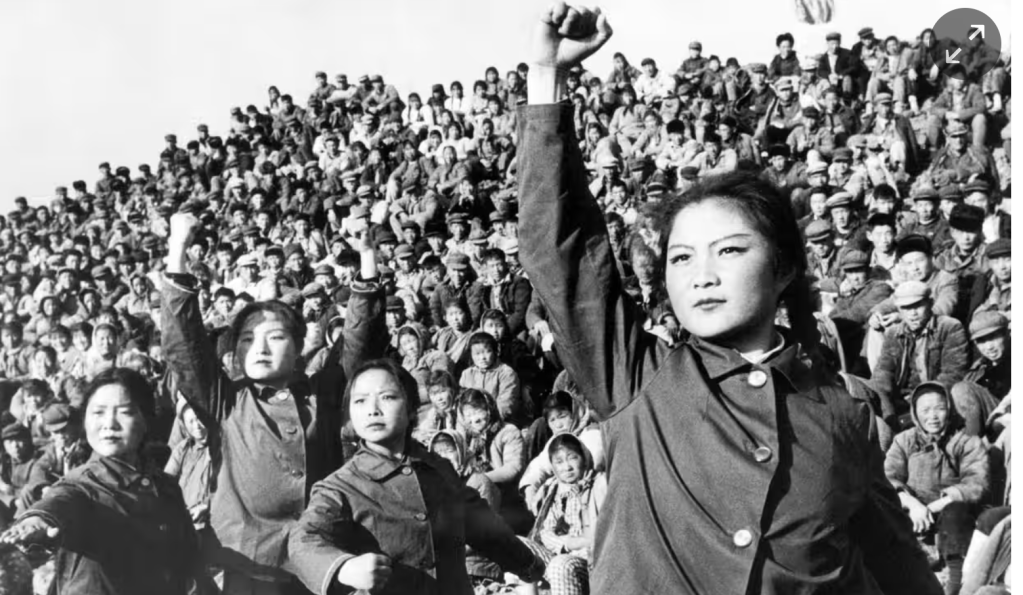
The rebels organized themselves as “Red Guards.”  First they were mainly students, but soon masses of young workers and peasants joined, reaching  30-40 million !

The socialist bureaucrats felt threatened. They organized their own “red guards.” These right-wing red guards fought to crush the left. The left fought back.

Things came to a head in Shanghai, China’s largest industrialized city. In January,1967, after a bloody fight, the left took over the city, chasing out the socialist bureaucrats. They established the Shanghai Commune, modeled after the Paris Commune of 1871.

Unfortunately, it did not last long. They sent a delegation to Beijing to proudly tell Mao what they had accomplished.  Mao panicked, rejecting the Shanghai Commune idea. He ordered them to instead set up a “revolutionary committee” like elsewhere, which was controlled by the socialist state, with representatives of the military, the party bureaucracy, and selected “red guards.” It was a trick to defeat the left. 

The Left’s big mistake was believing in Mao. Red Guards trusted his leadership, rather than starting their own Communist Party to fight directly for communism, and build a base for it in the army, which by then was controlled by the capitalist roaders. 

Responding to the Shanghai Commune, the army and right-wing Guards attacked the left throughout  China, killing thousands. The fighting continued, involving millions, but in 1968, Mao sent the left Red Guard youth to the countryside (out of trouble), supposedly to learn from the peasants. The GPCR was crushed by the “red Bourgeoisie” the Red Guards fought against. 

The GPCR stands as a beacon today for the international communist movement.  It was a revolution against socialism. It shows that the masses will fight for a communist lifestyle, and for aspects of communism as they understood it. 

[Return to entries]

[TRADUCCIÓN PROVISIONAL]

La Gran Revolución Cultural Proletaria (GRCP) comenzó el 25 de mayo de 1966. Una joven colocó su cartel de gran tamaño «Encender la Revolución Cultural».
La agitación resultante contra la «burguesía roja» se había estado gestando desde la victoria de la revolución en 1949.
La revolución china fue hecha por comunistas liderados por el PCC y su Ejército Rojo y milicia de masas.
Durante la guerra civil, el Ejército Rojo operó bajo el sistema de suministro igualitario. Los soldados donaron su trabajo para apoyar la producción y luchar. Sus necesidades básicas se cubrían sin dinero. Nadie tenía privilegios. Todos luchaban colectivamente, ayudaban a cultivar alimentos y vivían en las mismas condiciones.
Este estilo de vida comunista y el compromiso de derrotar a los opresores atrajeron a muchos campesinos e incluso soldados del ejército capitalista nacionalista. Muchos se unieron a la lucha revolucionaria cuando vieron el respeto mutuo y la colectividad del Ejército Rojo.
Pero poco después de la victoria en 1949, el nuevo gobierno abolió el sistema de abastecimiento. Introdujeron un sistema salarial con escalas salariales y rangos, basado en el modelo socialista soviético.
En 1958, Mao lanzó el Gran Salto Adelante (GSA). Los antiguos soldados del Ejército Rojo buscaban volver al estilo de vida comunista del Ejército Rojo. Construyeron el movimiento de comunas populares con el apoyo inicial de Mao. Las comunas de 300 000 o más personas producían alimentos y manufacturaban bienes sin dinero. Hombres y mujeres compartían el trabajo, las tareas domésticas y la participación en la vida política.
Al mismo tiempo, Mao prometió que la GLF produciría un gran aumento de la producción. Desafortunadamente, el aumento de la producción nunca se materializó. Los rivales nacionalistas abiertamente capitalistas de Mao tomaron la delantera.
Mao, un centrista, trató de movilizar a los comunistas para derrotar a sus enemigos. Llamó correctamente a sus rivales «seguidores del camino capitalista» y creó el Grupo de la Revolución Cultural (GRC).
Su apoyo ayudó a desatar una ola de rebeliones. Millones de personas estaban cada vez más hartas de las políticas socialistas de desigualdad, jerarquías y privilegios para unos pocos.
Los rebeldes se organizaron como «guardias rojos». Al principio eran principalmente estudiantes, pero pronto se unieron masas de jóvenes trabajadores y campesinos, ¡llegando a ser entre 30 y 40 millones!
Los burócratas socialistas se sintieron amenazados. Organizaron sus propios «guardias rojos». Estos guardias rojos de derechas lucharon para aplastar a la izquierda. La izquierda contraatacó.
Las cosas llegaron a un punto crítico en Shanghái, la ciudad industrializada más grande de China. En enero de 1967, después de una sangrienta lucha, la izquierda tomó el control de la ciudad, expulsando a los burócratas socialistas. Establecieron la Comuna de Shanghái, siguiendo el modelo de la Comuna de París de 1871.
Por desgracia, no duró mucho. Enviaron una delegación a Pekín para contarle con orgullo a Mao lo que habían logrado. Mao entró en pánico y rechazó la idea de la Comuna de Shanghái. En su lugar, ordenó que establecieran un «comité revolucionario» como en otros lugares, controlado por el Estado socialista, con representantes del ejército, la burocracia del partido y «guardias rojos» seleccionados. Fue una treta para derrotar a la izquierda.
El gran error de la izquierda fue creer en Mao. Los guardias rojos confiaron en su liderazgo, en lugar de crear su propio Partido Comunista para luchar directamente por el comunismo y construir una base para él en el ejército, que para entonces estaba controlado por los seguidores del camino capitalista.
En respuesta a la Comuna de Shanghái, el ejército y los guardias de derecha atacaron a la izquierda en toda China, matando a miles de personas. La lucha continuó, involucrando a millones, pero en 1968, Mao envió a la juventud de la Guardia Roja de izquierda al campo (fuera de problemas), supuestamente para aprender de los campesinos. El GPCR fue aplastado por la «burguesía roja» contra la que lucharon los guardias rojos.
La GPCR sigue siendo hoy un faro para el movimiento comunista internacional. Fue una revolución contra el socialismo. Demuestra que las masas lucharán por un estilo de vida comunista y por aspectos del comunismo tal y como lo entendían.

[Volver a las entradas]

Socialism/Socialismo

Many people are confused about the difference between socialism and communism. Many think that socialism is simply a less radical, more ‘democratic’ form of communism.

This is not true. Communism and socialism are opposites. Communism is a system in which the masses worldwide will collectively plan, produce and distribute everything only to meet the needs of the international working class. It will have no private ownership of the means of production or the land, no money, and no wage slavery. It will eliminate profits and capitalists. Instead of money and power dictating relations between people, trust and cooperation will guarantee our collective future, wellbeing and development.

Socialism has always retained money, wage work and a market economy. Socialism is capitalism managed by people who supposedly “care” about workers. Under socialism the state may own (some of) the means of production but that allows the socialist bosses to exploit the workers through the state – in the name of ‘the people’.

Socialism is state capitalism.

Marx, the founder of scientific communism, thought the masses needed a transition phase between capitalism and communism. He, Engels, and Lenin thought, wrongly, that the masses wouldn’t accept communist ideas or communistic living immediately after a revolution. They thought the masses had to be bribed with wages to produce for the good of all. We now know that they were wrong. They underestimated the masses’ yearning for a world of collectivity, free from wage slavery, the market, money and bosses.

Early Bolsheviks in Russia thought building up capitalist productive forces would create the material basis of communism. But socialism did not become communism. Keeping profits, the leaders became capitalist exploiters. 

The Chinese revolution followed the same model. However, the development of socialism in China was challenged by the massive Cultural Revolution of the 1960s. The Cultural Revolution was basically a rebellion against socialism in favor of ending privilege, ranks and pay scales, against the “red Bourgeoisie.” Many in the red army had lived a communistic lifestyle. They yearned for it. But the rebels had neither a party of their own nor a base in the armed forces. They were ultimately defeated. But their mass struggle showed that workers are open to fighting for aspects of communism, as they understood them.

After the defeat of the Cultural Revolution, China became the capitalist/imperialist state it is today.

Today the leading form of socialism deserves to be called “nationalist socialism”. This is the socialism practiced by nationalists after a “victorious” national liberation struggle. Fidel Castro is the poster boy for this kind of socialism. We can add Kwame Nkrumah and more recently Hugo Chavez. All their economies have been subject to the crises of capitalism, with its attacks on the workers.. 

Socialism has proved a disaster for workers just like all other forms of capitalism. 

The ICWP rejects socialism and the idea of a transitional stage. We are fighting directly for communism. Once the communist masses take power, we will end banks, money and wages. Communist collectives will plan and carry out production to meet the needs of all and distribute it to all based on need. Abolishing the wage system, the material basis for sexism, racism and homophobia, communist masses will wage a successful struggle to end all vestiges of these evils. When Communist workers’ power is victorious everywhere, we will eliminate all borders and nations. The international working class will be the human race! 

ICWP has confidence that the masses everywhere will embrace communist ideas and communist struggle as their own. Then class society will bhttps://icwpweb.com/2024/11/14/entries/e swept into the garbage bin of history forever.

[RETURN TO ENTRIES]

[TRADUCCIÓN PROVISIONAL]

Mucha gente no distingue entre socialismo y comunismo. Muchos piensan que el socialismo es simplemente una forma menos radical y más «democrática» de comunismo.
Esto no es cierto. El comunismo y el socialismo son opuestos. El comunismo es un sistema en el que las masas de todo el mundo planificarán, producirán y distribuirán colectivamente todo para satisfacer las necesidades de la clase trabajadora internacional. No habrá propiedad privada de los medios de producción ni de la tierra, ni dinero, ni esclavitud asalariada. Eliminará los beneficios y a los capitalistas. En lugar de que el dinero y el poder dicten las relaciones entre las personas, la confianza y la cooperación garantizarán nuestro futuro colectivo, nuestro bienestar y nuestro desarrollo.
El socialismo siempre ha conservado el dinero, el trabajo asalariado y la economía de mercado. El socialismo es el capitalismo gestionado por personas que supuestamente se «preocupan» por los trabajadores. Bajo el socialismo, el Estado puede poseer (algunos de) los medios de producción, pero eso permite a los jefes socialistas explotar a los trabajadores a través del Estado, en nombre del «pueblo».
El socialismo es capitalismo de Estado.
Marx, el fundador del comunismo científico, pensaba que las masas necesitaban una fase de transición entre el capitalismo y el comunismo. Él, Engels y Lenin pensaron, erróneamente, que las masas no aceptarían las ideas comunistas o la vida comunista inmediatamente después de una revolución. Pensaron que había que sobornar a las masas con salarios para que produjeran por el bien de todos. Ahora sabemos que estaban equivocados. Subestimaron el anhelo de las masas por un mundo de colectividad, libre de esclavitud salarial, mercado, dinero y jefes.
Los primeros bolcheviques en Rusia pensaron que la construcción de las fuerzas productivas capitalistas crearía la base material del comunismo. Pero el socialismo no se convirtió en comunismo. Al quedarse con los beneficios, los líderes se convirtieron en explotadores capitalistas.
La revolución china siguió el mismo modelo. Sin embargo, el desarrollo del socialismo en China se vio desafiado por la masiva Revolución Cultural de la década de 1960. La Revolución Cultural fue básicamente una rebelión contra el socialismo a favor del fin de los privilegios, los rangos y las escalas salariales, contra la «burguesía roja». Muchos en el ejército rojo habían vivido un estilo de vida comunista. Lo anhelaban. Pero los rebeldes no tenían un partido propio ni una base en las fuerzas armadas. Al final fueron derrotados. Pero su lucha masiva demostró que los trabajadores están abiertos a luchar por aspectos del comunismo, tal como los entendían.
Tras la derrota de la Revolución Cultural, China se convirtió en el estado capitalista/imperialista que es hoy.
Hoy en día, la forma principal de socialismo merece ser llamada «socialismo nacionalista». Este es el socialismo practicado por los nacionalistas después de una lucha de liberación nacional «victoriosa». Fidel Castro es el ejemplo de este tipo de socialismo. Podemos añadir a Kwame Nkrumah y, más recientemente, a Hugo Chávez. Todas sus economías han estado sujetas a las crisis del capitalismo, con sus ataques a los trabajadores.
El socialismo ha demostrado ser un desastre para los trabajadores al igual que todas las demás formas de capitalismo.
El PCOI rechaza el socialismo y la idea de una etapa de transición. Luchamos directamente por el comunismo. Una vez que las masas comunistas tomen el poder, acabaremos con los bancos, el dinero y los salarios. Las colectividades comunistas planificarán y llevarán a cabo la producción para satisfacer las necesidades de todos y distribuirla a todos en función de las necesidades. Aboliendo el sistema salarial, la base material del sexismo, el racismo y la homofobia, las masas comunistas librarán una lucha exitosa para acabar con todos los vestigios de estos males. Cuando el poder de los trabajadores comunistas sea victorioso en todas partes, eliminaremos todas las fronteras y naciones. ¡La clase obrera internacional será la raza humana!
El PCOI confía en que las masas de todo el mundo adoptarán las ideas comunistas y la lucha comunista como propias. Entonces la sociedad de clases será arrojada a la basura de la historia para siempre.

[VOLVER A LAS ENTRADAS]

Fascism / Fascismo

Fascism is the form capitalism takes when it is in crisis, needs to attack the working class harder, and is preparing for World War. It is the naked rule of capital, with the mask of democracy ripped off.

The capitalist and imperialist rulers want us to believe that they are all-powerful. That they can get away with anything they want. But the mass response to fascist terror shows that they are creating millions of anti-fascist, anti-genocide, and anti-racist fighters internationally. That means there is a great opportunity to convert these millions of youth, workers, soldiers and others into revolutionary communists to build a mass party to bury capitalism-imperialism forever.

The capitalist and imperialist rulers prefer to rule with a velvet glove covering their iron fist of wage slavery, exploitation, racism and war. They want the masses to believe we live in a “democracy” where everyone gets a voice.

But, as the capitalist system sinks deeper into inevitable crises of overproduction, as workers are massively laid off, as markets shrink because workers can’t afford to buy the products they need, the competition between different capitalists for that shrinking market sharpens. 

The top imperialists, US vs China and Russia, prepare for world war over which one will control the world’s markets, resources and workers’ labor power. They need fascism to terrorize and discipline the working class into accepting lower wages and back-breaking working conditions, and war They need to scape-goat groups of workers, blaming them for the problems that the capitalists themselves and their profit system have created. 

Worldwide, today, the rulers blame immigrants for capitalism’s growing unemployment. At the same time that they desperately need immigrant labor for their factories, fields and war machines. They are pushing nationalism/xenophobia and racism to try to divide and terrorize our whole class.

How to combat fascism—and end it

Fascism is the inevitable result of capitalism in crisis. As it grows, social democrats or liberals push elections for “anti-fascist” or less fascist candidates. It is a a deadly diversion and diversion to try to reform capitalism to be less fascist, to go back to the “good old days” of democracy.

The only way to end fascism is by going forward to build unity of workers of all “races” for communist revolution, which will put an end to capitalism, its wage slavery and its borders. We are fighting for a share and share alike communist world without borders, nations, racism or sexism. Where we produce only for human need, not for profit. Where the working class collectively plans, produces and distributes everything to meet the needs of the international working class.

United front against fascism or mass International Communist Workers’ Party?

International communist leaders made a deadly error in 1935. They told communists to fight fascism first and for communism later (later never came). They formed a united front with supposedly “lesser evil” capitalists and imperialists against fascism. At great sacrifice, especially by Russian workers, they defeated Hitler and Mussolini in WWII. But they left capitalism intact everywhere.

We are enduring the results of that error today. In Trump’s USA, Modi’s India, in Putin’s Russia and Bukele’s El Salvador open fascists are emerging. Capitalism is again in crisis. World War is in the horizon. We cannot make the same mistakes as communists made in the 20th century—fighting the symptoms but not the disease.

Today we fight attacks on immigrants, genocide in Gaza, and all the bosses’ attacks, putting forward the solution: a communist world without borders, wage slavery, genocide, or imperialist wars.

We are fighting to build a mass party to overthrow fascist capitalism worldwide and build communism. Join us!

[RETURN TO ENTRIES]

[TRADUCCIÓN PROVISIONAL]

El fascismo es la forma que adopta el capitalismo cuando está en crisis, necesita atacar más duramente a la clase trabajadora y se prepara para la guerra mundial. Es el gobierno desnudo del capital, con la máscara de la democracia arrancada.

Los gobernantes capitalistas e imperialistas quieren que creamos que son todopoderosos. Que pueden salirse con la suya. Pero la respuesta masiva al terror fascista muestra que están creando millones de luchadores antifascistas, antigénocidas y antirracistas a nivel internacional. Eso significa que existe una gran oportunidad para convertir a estos millones de jóvenes, trabajadores, soldados y otros en comunistas revolucionarios para construir un partido de masas que entierre el capitalismo-imperialismo para siempre.

Los gobernantes capitalistas e imperialistas prefieren gobernar con un guante de terciopelo que cubra su puño de hierro de esclavitud salarial, explotación, racismo y guerra. Quieren que las masas crean que vivimos en una «democracia» donde todos tienen voz.

Pero, a medida que el sistema capitalista se hunde más profundamente en crisis inevitables de sobreproducción, los trabajadores son despedidos masivamente, los mercados se contraen porque los trabajadores no pueden permitirse comprar los productos que necesitan, la competencia entre los diferentes capitalistas por ese mercado en contracción se agudiza.

Los principales imperialistas, EE. UU. contra China y Rusia, se preparan para la guerra mundial por el control de los mercados, los recursos y la mano de obra del mundo. Necesitan el fascismo para aterrorizar y disciplinar a la clase trabajadora para que acepte salarios más bajos y condiciones de trabajo agotadoras, y la guerra. Necesitan grupos de trabajadores chivos expiatorios, culpándolos de los problemas que los propios capitalistas y su sistema de ganancias han creado.

Hoy en día, en todo el mundo, los gobernantes culpan a los inmigrantes del creciente desempleo del capitalismo. Al mismo tiempo que necesitan desesperadamente mano de obra inmigrante para sus fábricas, campos y máquinas de guerra. Están impulsando el nacionalismo/xenofobia y el racismo para tratar de dividir y aterrorizar a toda nuestra clase.

Cómo combatir el fascismo y acabar con él

El fascismo es el resultado inevitable del capitalismo en crisis. A medida que crece, los socialdemócratas o liberales impulsan elecciones para candidatos «antifascistas» o menos fascistas. Es una distracción mortal intentar reformar el capitalismo para que sea menos fascista, para volver a los «buenos viejos tiempos» de la democracia.

La única manera de acabar con el fascismo es avanzar para construir la unidad de los trabajadores de todas las «razas» para la revolución comunista, que pondrá fin al capitalismo, su esclavitud salarial y sus fronteras. Luchamos por un mundo comunista compartido y equitativo sin fronteras, naciones, racismo o sexismo. Donde producimos solo para satisfacer las necesidades humanas, no para obtener beneficios. Donde la clase trabajadora planifica, produce y distribuye colectivamente todo para satisfacer las necesidades de la clase trabajadora internacional.

¿Frente unido contra el fascismo o Partido Comunista Obrero Internacional masivo?

Los líderes comunistas internacionales cometieron un error mortal en 1935. Les dijeron a los comunistas que lucharan primero contra el fascismo y después por el comunismo (el después nunca llegó). Formaron un frente unido con los capitalistas e imperialistas supuestamente «menos malos» contra el fascismo. Con un gran sacrificio, especialmente de los trabajadores rusos, derrotaron a Hitler y Mussolini en la Segunda Guerra Mundial. Pero dejaron el capitalismo intacto en todas partes.

Hoy estamos sufriendo las consecuencias de ese error. En los Estados Unidos de Trump, en la India de Modi, en la Rusia de Putin y en el El Salvador de Bukele están surgiendo fascistas abiertos. El capitalismo está de nuevo en crisis. La guerra mundial está en el horizonte. No podemos cometer los mismos errores que los comunistas cometieron en el siglo XX:combatir los síntomas pero no la enfermedad.

Hoy luchamos contra los ataques a los inmigrantes, el genocidio en Gaza y todos los ataques de los jefes, proponiendo la solución: un mundo comunista sin fronteras, esclavitud salarial, genocidio o guerras imperialistas.

Luchamos por construir un partido de masas para derrocar el capitalismo fascista en todo el mundo y construir el comunismo. ¡Únete a nosotros!

[VOLVER A LAS ENTRADAS]